
Near the halfway point of Route 66 – the US “Mother Road”, which will be a century old next month, at least in name – is a town called Shamrock.
It’s not mentioned in the eponymous song, unlike Amarillo, Flagstaff, Winona and many other places where it’s said you can get your “kicks” on the journey from Chicago to Los Angeles.
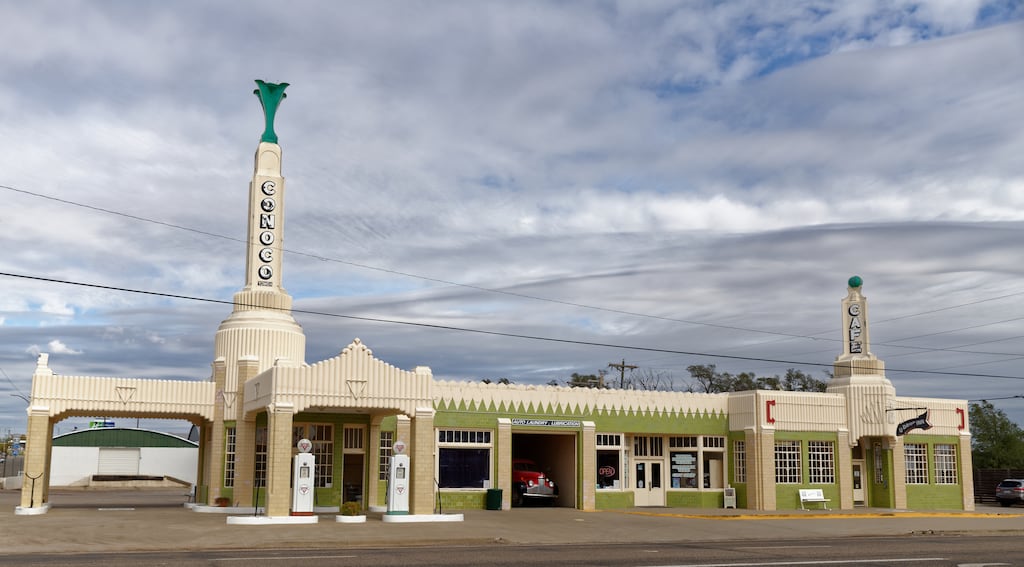
But it does have one of the route’s classic buildings, constructed in the art deco style that became visually synonymous with the route’s glory days.
The U-Drop Inn was built in 1936 as a cafe and filling station servicing motorists on the increasingly busy road. Closed in the 1990s, it was then restored as a museum and visitor centre.
An officer and a Dublin man: Frank McNally on ‘perhaps the most brilliant general in British history’

Forever Auvers – Frank McNally on the village where Vincent van Gogh spent his last days

A nicer kind of riot – Frank McNally on the Irish cultural storming of Paris

Eileen Gray was evicted from a Paris grave. Her ashes remain lost but a new memorial has been created
And when Pixar eulogised Route 66 in its 2006 animated movie Cars, set in the fictional Radiator Springs, the town’s garage bore the U-Drop Inn’s unmistakable outline.
Details of how Shamrock acquired its name are now somewhat obscured by the mists of history, American style.
It was so christened in the 1890s by a man named variously as George Nickle or Nichol(s) who, in some accounts, was an Irish emigrant and, in others, just had a mother from here.
Either way, according to the Texas State Historical Association, he won permission to open a post-office in his home (described by the TSHA as a “dug-out”). And since the postal system required a place name, he chose Shamrock “for good luck and courage”.
However, that post office never opened because, with the luck of the Irish, George’s home burned down. Then another man opened a post office and called it “Exum”, his own surname. But when the Rock Island Railroad came through here, circa 1903, it overruled that and called the stop Shamrock.
[ Strong words: America’s ‘greatest diarist’ whose many dislikes included the IrishOpens in new window ]
Thus, before the famous road, the town owed its existence to a famous railway: the “Rock Island Line”, also celebrated in song.
Other hamlets in the area included one called Story. That, aptly, was home to the local newspaper, the Wheeler County Texan. But the paper relocated in 1928 to become the Shamrock Texan (Story seems to have been buried in the process) and further secure the town’s place on the map.
Tenuous as its links with Ireland may be, Shamrock claims to have a piece of the Blarney Stone set into a column in a local park. The plaque says it was “imported & erected in 1959” and officially dedicated on St Patrick’s Day of that year.
The town is not unique in the US, or even in Texas, for purporting to have such a relic. Texas Tech University, in Lubbock, claims to have a bit of the stone too. And such is the hold the Blarney myth has on American imaginations; there have been attempts elsewhere in the US down the decades to buy the whole thing.
Anyway, inspired by its own supposed share, Shamrock greets visitors with a sign saying: “Top o’ the mornin’ to ya!” It also has a local college football team that, like a more famous one in South Bend, Indiana, calls itself the “Fighting Irish”.
Mind you, by one recent count, there are 52 US college football teams that style themselves “Fighting Irish”, “Fightin’ Irish”, or just “Irish”. Maybe Ireland should seek Unesco intangible heritage list protection for its reputation in this sphere. Or maybe not.
The exact midway point of Route 66 is in a township called Adrian, about 140 miles west of Shamrock, on the other side of Amarillo. There, a sign points to the opposite destinations of Chicago and LA and informs you that both are 1,139 miles away. The official midpoint is also marked with a white line across the road, much photographed by passers-by.
Adrian’s slogan recognises the town’s essential transience: “When you’re here, you’re halfway there”. Not many people are “here” permanently. At the last census, the population was 128.
Route 66 was itself always a transient phenomenon, continually changing. The imminent centenary is of the adoption on November 11th, 1926, of a uniform highway numbering system, replacing the former patchwork of unconnected roads and trails.
That became a promotional opportunity for places along the route and, at first, even numbers were considered most prestigious. The “Mother Road”, as John Steinbeck would immortalise it in The Grapes of Wrath, would have been Route 60 if an early promoter had had his way.
Route 62 was then briefly considered. But even after the road acquired its now celebrated number, it was another 12 years before it became fully connected and paved from end to end.
That was just in time for Steinbeck’s Dust Bowl epic, set on the section between Oklahoma and California. The “kicks” song, recorded by Nat King Cole and many others after him, came a decade later.
But by the 1950s, Route 66 was already being bypassed by bigger, faster highways. It was officially decommissioned in 1985, before undergoing revival as a heritage attraction. On many surviving stretches, identifying markers must now be painted on the road itself, thanks to the popularity of detachable signs as souvenirs.